African Americans
Here's some description about African American History at NC State.
1880s
Ellen McGuire was an African American woman who began working at NC State in 1889. McGuire worked at NC State for 50 years and retired in 1939. According to a 1939 Technician article, McGuire was born into slavery on a North Carolina plantation. Although McGuire maintained many responsibilities, she spent the last 31 years working in the infirmary on campus.
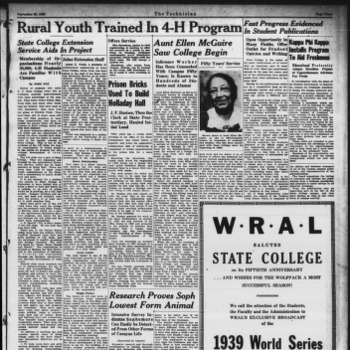 Technician, Vol. 20 No. 3 Section 6, September 29, 1939
1890s
The Second Morrill Act became law and required states to provide technical education for African Americans. No federal money would be disbursed to any college that made distinctions between students on the basis of race. In 1891, in order to comply with the Second Morrill Act and prevent admission of African Americans to the North Carolina College of Agriculture and Mechanic Arts, the state government created the North Carolina Agricultural and Technical College in Greensboro, NC.
1910s
Alexander Bailey was hired by the North Carolina Agricultural Experiment Station (located at A&M College) as the first African American agricultural extension agent.
The first club for African American youth was created in Sampson County under the leadership of G. W. Herring.
John Wray became the first statewide African American youth club agent.
The first Home Demonstration programs were organized for African American women.
1920s
The first State 4-H Short Course for African American youth was held at North Carolina A&T College in Greensboro.
1950s
The Consolidated University of North Carolina declared that African American students were eligible for admission into graduate programs.
In 1953, NC State College hosted a dairy farm conference on campus. Chancellor Bostian declared that African American dairy farmers attending the conference could only eat in the west wing of the dining hall. Bostian's announcement was in keeping with the College's policy, which declared African Americans attending on campus meetings would have meals in the dining hall but only when a separate room was available. Leazar Hall served as the campus-dining hall until 1971.
State College admitted two African American graduate students into the School of Engineering: Robert Clemons and Hardy Liston. Clemons became the college's first black graduate. Liston withdrew and didn't complete his degree.
In Frazier v. the Board of Trustees of the University of North Carolina, the court determined that undergraduate colleges and universities should be open to African Americans.
Camp J. W. Mitchell opened for African American 4-H youth at Hammock's Beach in Onslow County. Funding for the camp was raised by the 4-H Club Foundation of North Carolina founded in 1950.
The first four African American undergraduates enrolled at North Carolina State College: Ed Carson (electrical engineering), Manuel Crockett (electrical engineering), Irwin Holmes (electrical engineering), and Walter Holmes (mechanical engineering, aerospace option).
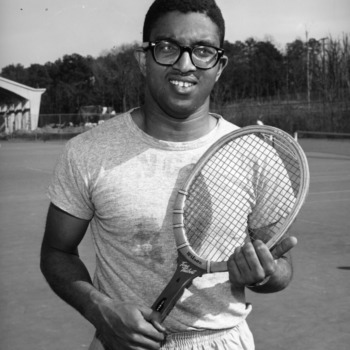 Irwin Holmes on tennis court
Walter Holmes joined the marching band and the concert band during his first semester at State College in 1956. Holmes's presence in the band complicated segregation laws in stadiums and dining halls throughout the south. In 1957, Holmes dined with the band in the Clemson College dining hall. South Carolina residents circulated a petition asking Governor Timmerman "to see that such racial mixing doesn't occur again, especially when N.C. State visited ... More
Robert Clemons received a professional degree in electrical engineering (PREE) and became the first African American to graduate from NC State.
African American student Irwin Holmes joined the men's tennis team making it the first integrated athletic team at State College.
The first African American woman hired as an academic staff member, Justina Williams, worked in the Department of Genetics's drosophila research lab. Many African Americans worked at State prior to Williams's appointment, however, they primarily worked in custodial or food service positions.
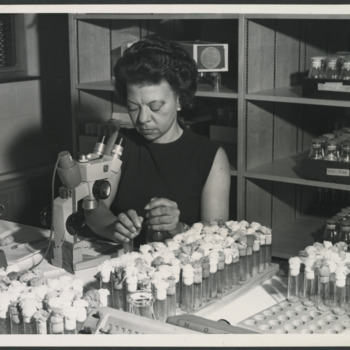 Justina Williams conducting genetics research
1960s
Irwin Holmes became co-captain of the tennis team and first African American athletics team captain at NC State.
Edward Carson was the first African American student employed at the Libraries. He later served on the Board of Directors for the Friends of the Library.
Student government passed a resolution calling for racial integration of public facilities in Raleigh and formed the Human Relations Committee to write letters to area merchants. This movement was followed by a similar resolution from Faculty Senate.
Irwin Holmes earned a BS in electrical engineering, making him the first African American undergraduate to receive a degree at NC State. Further documentation of Irwin Holmes's life exists at DigitalNC.
Hazel Virginia Clark received a master's degree in occupational information and guidance. She was the first African American woman to receive a master's degree from NC State.
Edward Walker, the first full-time African American staff member of the library, was hired as the mail clerk.
Vivian Henderson became the first African American faculty member after taking a position as a visiting professor in the Department of Economics. Henderson was a friend of MLK Jr., and he later became president of the historically black Clark College in Atlanta, GA.
Baxley's on Hillsborough Street was the first restaurant near NC State's campus to serve African Americans.
A group of NC State students joined with students from Shaw University to protest racial segregation policies in effect at the State Theater on Salisbury Street.
![Technician, Vol. 47 No. 76 [Vol. 43 No. 76], May 1, 1963](https://iiif.lib.ncsu.edu/iiif/technician-v47n76-1963-05-01_0001/!square/350,/0/default.jpg) Technician, Vol. 47 No. 76 [Vol. 43 No. 76], May 1, 1963
Technician, Vol. 47 No. 76 [Vol. 43 No. 76], May 1, 1963Claude A. Verbal Sr. was the third African-American to graduate from NC State and the first African American graduate of mechanical engineering.
Doretha Blalock was hired as a "Typist II" for the library in 1964. She was later the first African American woman employed above the clerk level in a technical position processing books and was promoted to supervisor of the Collections Management Department. She also worked on the Affirmative Action Committee which oversaw hiring of African Americans in the 1970s.
Dorothy Williams became the first African American instructor with faculty ranking in the Department of Sociology and Anthropology.
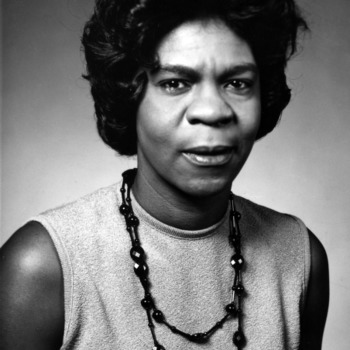 Dorothy S. Williams, NC State University Faculty
Extension programs, including 4-H and Home Economics, began to integrate.
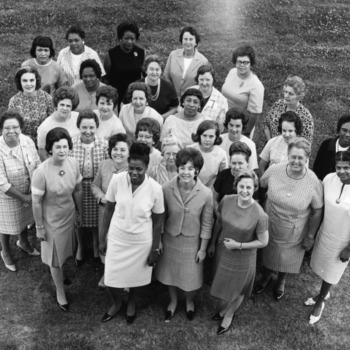 Home economics extension workers, June 12, 1967
In 1966, the university pressured local landlords to rent to African American students. In response, some landlords wrote angry letters to Chancellor Caldwell.
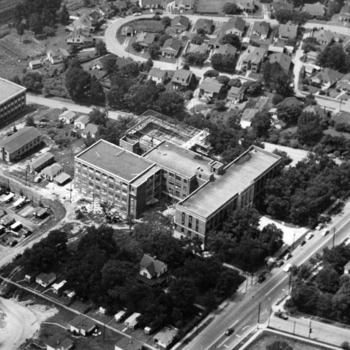 Nelson Hall, aerial view
Norma Wright Garcia became the first African American woman to receive an undergraduate degree after earning a BA in history.
When Raleigh landlords refused to rent to African American students, student leaders formed Direct Action for Racial Equality (DARE) to advocate for equal housing opportunities for African American students.
Martin Luther King Jr. spoke at Reynolds Coliseum to a crowd of over 5,000 individuals as well as a television audience of WUNC-TV. At the same time as the event, Klu Klux Klan members marched in violent protest in downtown Raleigh. Despite this, King continued with his speech.
Cooper became the first African American athlete at NC State to receive a grant-in-aid. He began playing on the freshman basketball team in the fall of 1967.
Stephen Benton Latimer received a PhD in animal science and became the first African American to earn a doctoral degree from NC State.
Marcus Martin was the first African American player to join the football team.
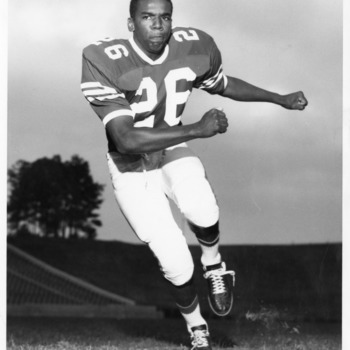 Marcus Martin, North Carolina State defensive back, 1967-1969
Alfred "Al" Heartley and William Cooper became the first African American members of the freshman basketball team. Heartley later went on to play on the varsity team.
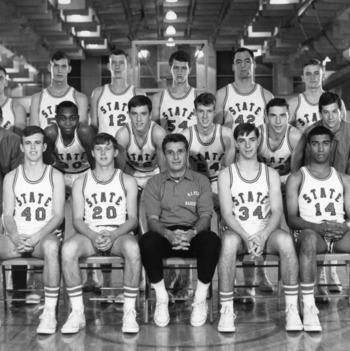 N.C. State freshmen basketball team, 1967
Al Heartley was one of the first African American players on the basketball team. In 1969, he became the first African American player to be awarded a basketball scholarship at NC State. He later became the first African American captain of the team (1970-1971) and the first African American athlete to win the Alumni Athletics trophy (1971).
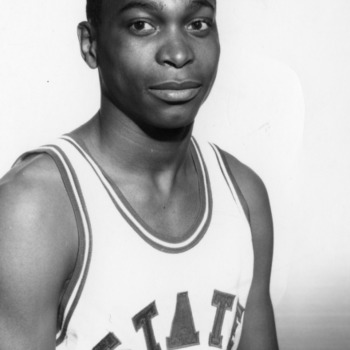 Guard Al Heartley, N.C. State University basketball
Nina Simone was the headline performer for New Arts Jazz Festival on October 30, 1968. She previously performed at Reynolds Coliseum for the "CARavan" show on April 10, 1964.
On the weekend of King's death, approximately 200 white students and faculty from UNC Chapel Hill, Duke, and NC State gathered in the Brickyard. The protestors intended to march on the State Capitol Building and present a petition to Governor Dan Moore. The march did not go forward as planned after the Raleigh Police Department stopped the group at Winston Hall, and Chancellor Caldwell pleaded with protesters to disperse peacefully. With threats of arrest ... More
Ed Leftwich joined the basketball team and was the first African American freshman to receive a basketball scholarship.
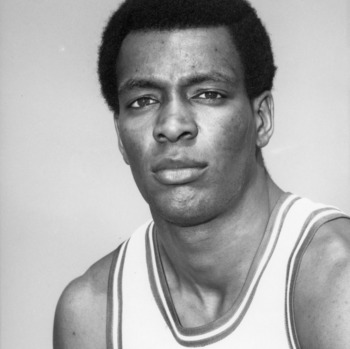 Ed Leftwich, N. C. State
In fall 1969, NC State began offering Black Studies courses. These courses included Black American literature, the Afro-American in America, Black Americans in American Politics, and Black Ideology. Previously, students were going to Shaw University and St. Augustine's College to take similar classes.
Eric Moore became the first African American student senate president.
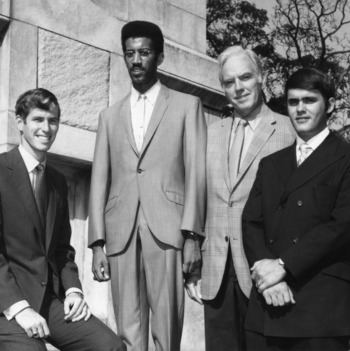 Chancellor John T. Caldwell posing with North Carolina State University student government officials, including Eric N. Moore, at Memorial Bell Tower
Clyde Chesney was the first African American to receive a football scholarship.
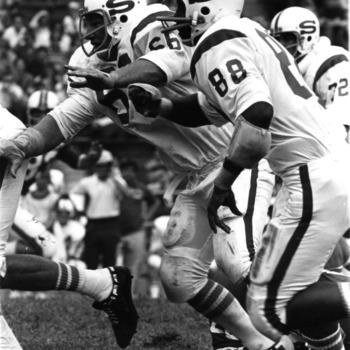 North Carolina State University defensive linemen Clyde Chesney (88) and George Smith (66)
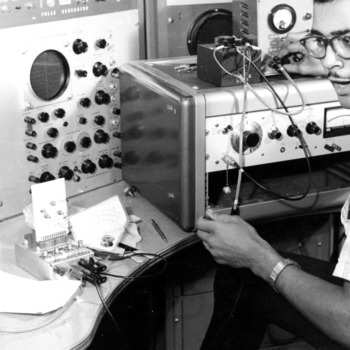 NC State University, Electrical Engineering Research
A group of students held a rally to support better wages and working conditions for physical plant workers on campus. The protest was organized by the Society of Afro-American Culture and an offshoot of Students for a Democratic Society known as "The Group."
Four African American women were fired from custodial positions in all-male dormitories. Sixteen employees then held a sit-in at the chancellor's office and protested the action. The protestors demanded improvements in pay and working conditions and were arrested for refusing to leave. That evening, African American students and employees marched to the Chancellor's Residence protesting these actions. The following day, janitorial and housekeeping services in residence halls were canceled.
1970s
Mary Evelyn Porterfield was elected the first African American "Miss NCSU." In an interview with the Technician, Porterfield stated, "If I had been the first Black homecoming queen ever at a university of this size, I think it would have weighed much more heavily on my emotions, but to me, by this time, it seems as ordinary as would have been any selection. I think State is three years behind in the trend...I realize that this is a victory for the ... More
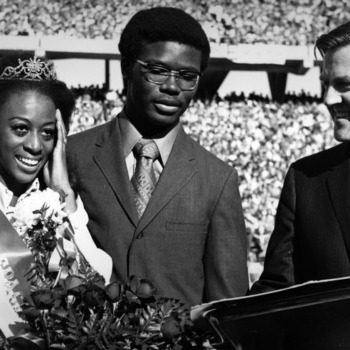 Homecoming Queen Mary Evelyn Porterfield with escort Michael Brown and Alumni Affairs director Bryce Younts
The Health, Education, and Welfare Department (HEW) informed the University of North Carolina schools that its institutions, including NC State, failed to comply with the Civil Rights Act of 1964.
Willie Burden and Charley Young became the first African American students to receive full football scholarships as incoming freshmen.
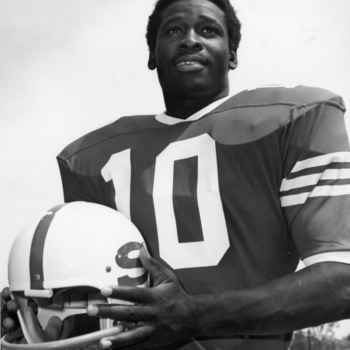 Willie Burden, North Carolina State running back, 1971-1973
Students formed NC State's first African American Cultural Center, which was given space in the YMCA building.
William V. Frazier was the first African American hired in a professional librarian position.
Augustus M. Witherspoon became the second African American to earn a PhD at NC State. He received a PhD in botany and was the first African American to receive a doctoral degree and then join the faculty.
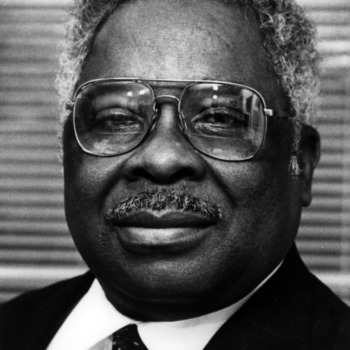 Augustus Witherspoon
Seven students founded a local chapter of Alpha Phi Alpha which was NC State's first African American fraternity.
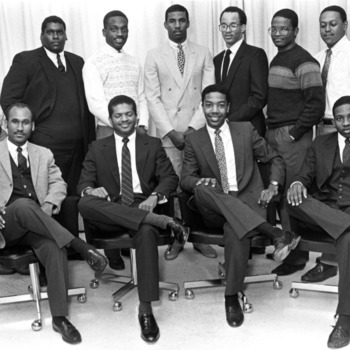 Alpha Phi Alpha fraternity group portrait
The Division of Student Affairs hired an African American counselor, made financial aid available to African American students, and encouraged the development of African American cultural programs.
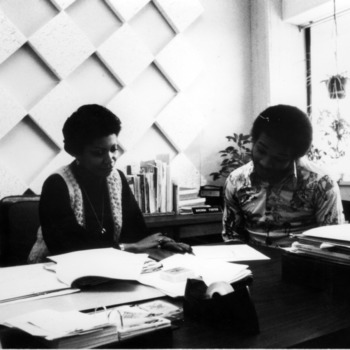 African American Students (1 of 6) :: People
The first African American student in the College of Textiles, James "Jim" Rucker, graduated with a BS in textile chemistry in 1971.
The first annual Pan Afrikan Festival began and continued until April 2, 1971. The festival featured lectures by C. T. Vivian and other speakers as well as musical performances.
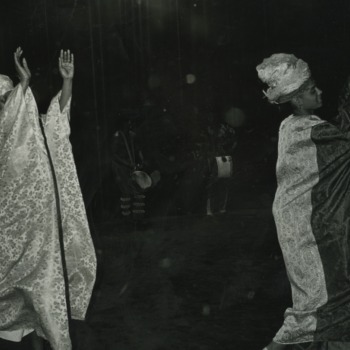 Dancers at Pan-African festival
Arthur Clement graduated with a bachelor's degree in architecture in the College of Design (formerly the School of Design).
William Maxwell became an assistant dean in the School of Education and NC State's first African American academic administrator.
NC State published "In a Black Perspective." This pamphlet totaled the university's black community at nine professors and 222 students (out of a total 13,809). The publication listed courses focusing on black history and culture: two in political Science and one on race relations in sociology.
Shirley Chisholm, the first African American congresswomen and presidential nominee, visited campus and spoke to an audience of 2,500.
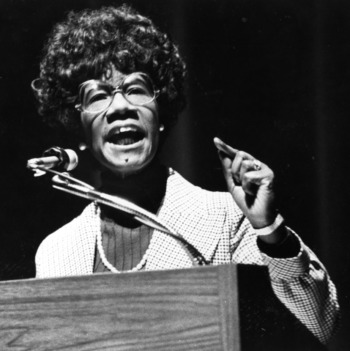 Shirley Chisholm speaking
Nannette Smith Henderson was the first African American woman awarded a PhD at NC State with a degree in plant pathology.
David Thompson was named NC State's first African American All-American winner in basketball. In 2012, he was inducted into the NC State Athletics Hall of Fame.
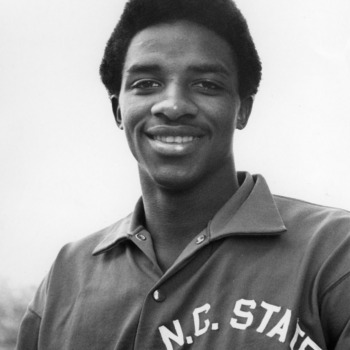 David Thompson
Margaret Hunt and Lillie Castor were the first two African American women hired as professional librarians to work at the D. H. Hill Jr. Library.
Dr. Lawrence M. Clark (1934-2012) was hired as Associate Provost. Dr. Clark was the second African American to serve as a university administrator. In addition to serving as a professor in mathematics education, Dr. Clark coordinated all activities related to the university's Affirmative Action Plan. Dr. Clark was instrumental in the founding of NC State's African American Cultural Center, the Peer Mentor program, and the African American Symposium.
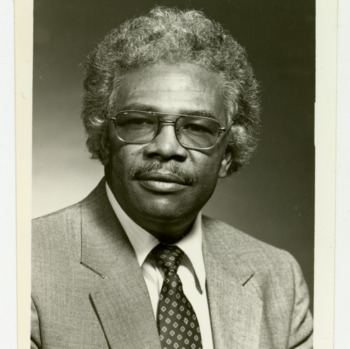 Lawrence M. Clark portrait
The university's affirmative action plan was informally accepted by the Health, Education, and Welfare Department (HEW).
In 1974, African American students called for a new cultural center. Student body president Terry Carroll presented a four-point request to Chancellor Caldwell, which included a request for the first floor of the Print Shop to be turned over to the Society of Afro-American Culture for an African American Cultural Center. Banks C. Talley, dean of Student Affairs, complied with this request.
A women's basketball team was established for the first time. The team included two African American women, Gwen Jenkins and Cynthia Steele.
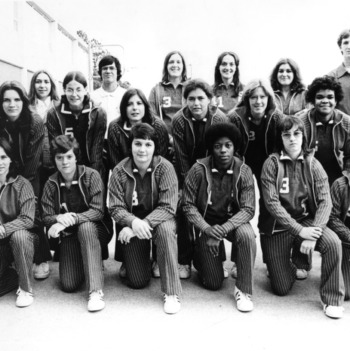 1974-1975 N.C. State University women's basketball team
A chapter of Delta Sigma Theta was established as the first African American sorority chapter on campus.
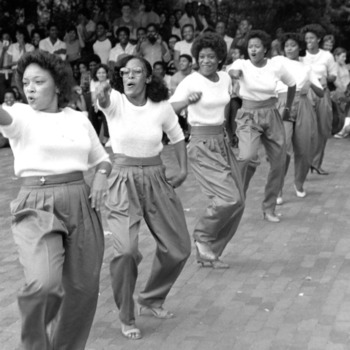 Sisters of Delta Sigma Theta during a step show
Civil rights leader C. T. Vivian conducted a race awareness seminar at NC State. For the next twenty years, Vivian returned to NC State periodically to conduct this seminar.
Philip Freelon graduated with a bachelor's of environmental design in architecture degree. Signature buildings his firm designed include the Harvey B. Gantt Center for African American Arts + Culture in Charlotte, NC; the International Civil Rights Center & Museum in Greensboro, NC; the Reginald F. Lewis Museum of Maryland African American History & Culture in Baltimore, MD; and the Smithsonian National Museum of African American History and Culture on ... More
Wilbert Johnson, the first African American assistant coach for men's basketball at NC State, was hired by head coach Norm Sloan.
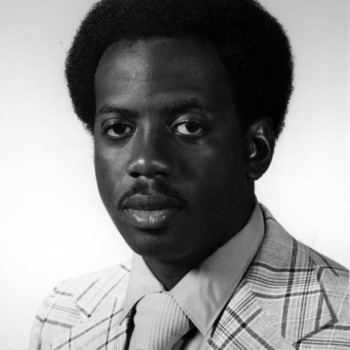 Coach Wilbert Johnson portrait
The AACC moved to the renovated Print Shop, later known as the West Dunn Building.
Hubert Winston became the first African American faculty member in the College of Engineering and the Department of Chemical Engineering. Dr. Winston was also the first African American to earn a PhD from the College of Engineering while studying chemical engineering.
This organization's mission was "to increase the number of culturally responsible Black engineers who excel academically, succeed professionally and positively impact the community."
A group of students formed the New Horizons Choir to sing gospel music. Eleania B. Ward was the group's original director. For a number of years, New Horizons sang services for the Black Student Fellowship.
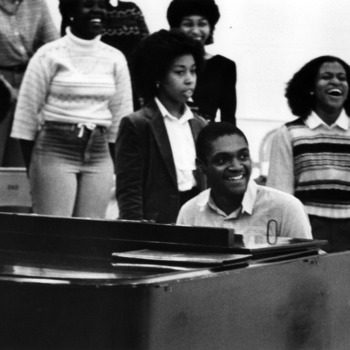 Performance by NC State's New Horizons Choir
This sorority was an international service organization established by African American college educated women.
The Association for the Concerns for African American Graduate Students was created as a student organization for all students seeking to address the needs, concerns, and interests of African American graduate students. This organization was recognized by the university in 1976 as the Association for the Concerns of Black Graduate Students. By 1983, it was known as the Association for the Concerns of Afro-American Graduate Students and was renamed again in late ... More
Ted Brown became the first African American player named an All-American in football. In 2012, he was inducted into the NC State Athletics Hall of Fame.
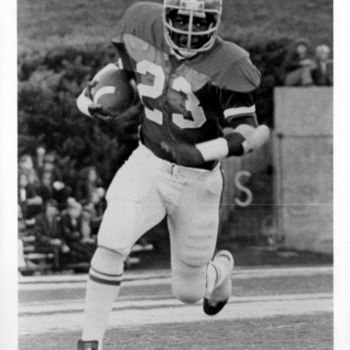 N. C. State football player Ted Brown running with football
Dr. Wilma C. Peebles-Wilkins joined the university's faculty as assistant professor for the social work program. Dr. Peebles-Wilkins was one of the first African American women to graduate from NC State, and she later served as associate department head and director of the social work program.
The Black Alumni Group, later the Black Alumni Society, was officially organized in 1979 and became an affiliate of the NC State Alumni Association.
In the Technician, one of the first African American women cheerleaders, Wanda Billingslea Farrell, called out the selection process for cheerleader tryouts as racist and biased.
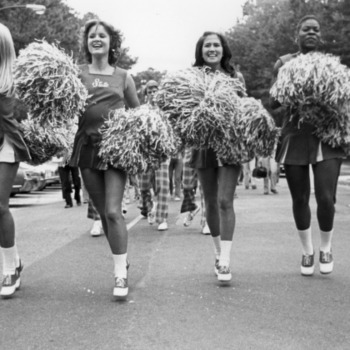 Cheerleaders in parade
1980s
This organization was a local chapter of the first fraternal organization founded on the campus of a historically black college.
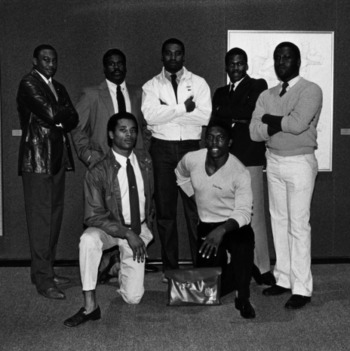 Omega Psi Phi
The Peer Mentor program paired freshman with upper-class mentors to aid in the academic, emotional, and social adjustment of African American students, and later all culturally diverse first-year students. An earlier program from 1980 to 1982 paired African American freshmen with faculty and staff members as mentors.
This fraternity was founded on the principles of brotherhood, scholarship, and service.
Chancellor Bruce Poulton instituted the first annual Brotherhood Dinner to honor African Americans who made important contributions to the nation and the world. The annual dinner continued for more than 25 years, and honorees included John Hope Franklin, Gwendolyn Brooks, C. T. Vivian, Julian Bond, and John Lewis. In 1978, there may have been an earlier brotherhood dinner honoring Samual Nesbritt.
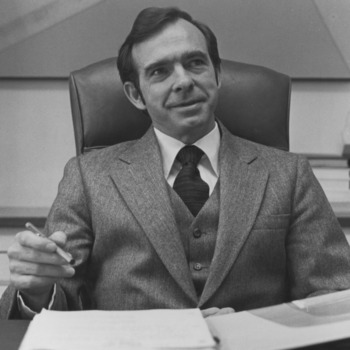 Chancellor Joab Thomas
Student Senate passed the Minority Affairs Bill, which created the Minority Affairs Committee. The committee was tasked with representing the concerns of African Americans, Native Americans, women, people with disabilities, and the gay and lesbian community on campus.
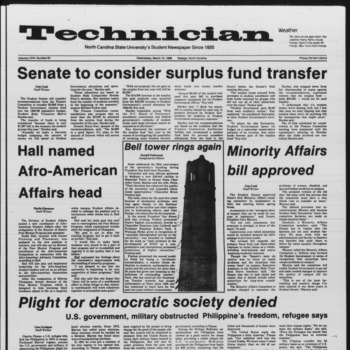 Technician, Vol. 67 No. 64, March 12, 1986
Student Government organized a march to protest NC State's financial involvement in South Africa. The anti-apartheid march began outside the African American Cultural Center and ended at the Memorial Tower. Approximately 75 students participated in the march.
Kevin Howell was the first African American to serve as student body president from 1987 to 1988. He was a political science major. After graduation, he was hired as the university's primary liaison with state and local governments.
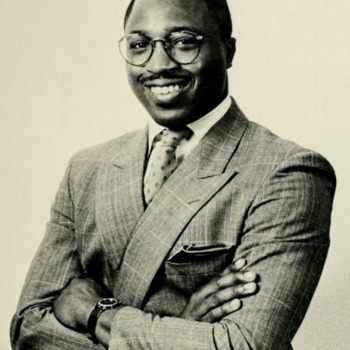 Kevin Howell, 1988
In fall 1988, NC State implemented an African American Studies minor, the first of its kind at the university. The interdisciplinary minor required students to take courses in both history and English literature.
African American student leaders gathered at the Student Center to discuss campus issues. The low graduation rate for African American students, the lack of African American faculty members and athletic administrators, and the discriminatory discipline practices within the athletics department were problems cited by leaders during this meeting.
NC State University recognized Martin Luther King Jr. Day for the first time in 1988. University administrators initially announced the substitution of Easter Monday for MLK day, however students reacted negatively to this suggestion. Student Body president Kevin Howell introduced an open forum to hear student concerns about the spring calendar changes. Upon hearing support for both holidays, Howell pushed the administration to observe both Easter and MLK day. ... More
Greeks United sponsored the March Against Racism-Challenging History (M.A.R.C.H.) to support change in the university's policies towards African American students. During the protest, students marched to the chancellor's office in Holladay Hall to present a petition that demanded immediate action. NC State's first African American student body president, Kevin Howell (1987-1988), participated in the M.A.R.C.H.
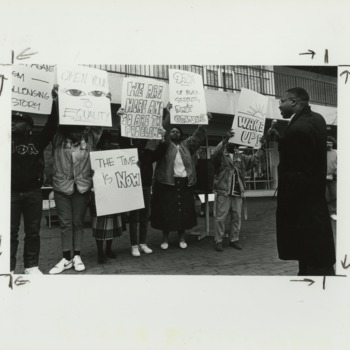 M.A.R.C.H. protest for African American equality, with Kevin Howell at the microphone
The Associate Provost position was created and was also called Facilitator of African American Affairs. It was first held by Dr. Augustus Witherspoon.
Christine Grant, a professor in chemical engineering, became the first African American woman appointed as faculty member in the College of Engineering.
Brian Nixon was the second African American to become student body president at NC State.
Enrollment of African American students passed 2,000, Latinx students passed 200, and international students passed 1,000.
Dwuan June was the first African American editor of the Technician student newspaper.
1990s
The Libraries' Collection Management department was established with African American employee Margaret Hunt as its first head.
Professor Harold Freeman was the first African American "named professor" in the College of Textiles. He was named the Ciba-Geigy Professor of Dyestuff Chemistry.
Student body president Brian Nixon was attacked near his dorm room in North Hall. Prior to this attack, public safety provided Nixon with security. Nixon received racial death threats and intimidating calls and letters throughout his presidency. As student body president, Nixon implemented programs that encouraged students to practice ethical behavior and allowed students to meet with campus leaders in informal settings. Nixon accomplished many successful programs ... More
This sorority was founded on the precepts of scholarship, service, finer womanhood and sisterly love.
The African American Cultural Center opened in the new Student Center Annex, later renamed the Witherspoon Student Center. In 1992, following months of student and faculty protests, NC State administrators granted the African American Cultural Center an operating budget.
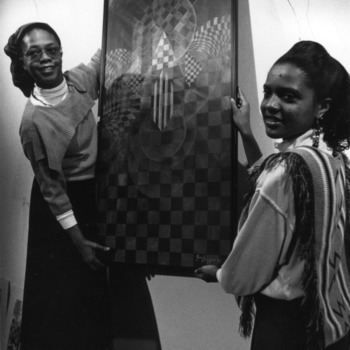 Dr. Iyailu Moses and other woman at the opening of the African American Center
Kedrick Lowery was elected Leader of the Pack, which had replaced the homecoming queen competition. Lowery was the first African American man to be honored with the title. Lowery was a member of Omega Psi Phi Fraternity and Alpha Kappa Psi Professional Business Fraternity.
Vincent Haley earned a Master's degree in Industrial Design. During his time at NC State, Haley developed an accessibility tool and software for computer users with disabilities called the Access Power Pointer.
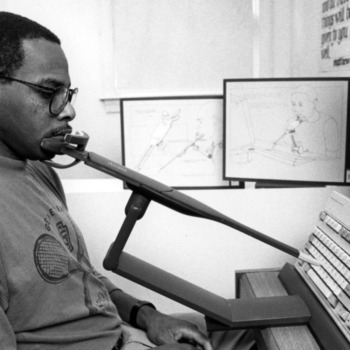 Graduate student Vincent L. Haley demonstrating his pointer device for computer accessibility
The Sista 2 Sistuh Network was established to support African American women at NC State.
James Anderson was the first African American dean after being appointed Dean of Undergraduate Studies.
The African American Textile Society (AATS) was formed in 1992 to support African American students in the College of Textiles.
The Nubian Message began publication in response to student protests alleging racial bias by the Technician. Tony Williamson served as the paper’s first editor-in-chief, and the paper was released in the Talley Student Center. In the inaugural issue, Williamson stated his intention to "totally, truthfully, and faithfully cover every aspect of African American life at NCSU" and his hope that the Nubian Message would become "the media voice for ... More
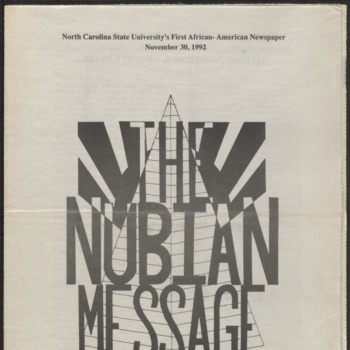 Nubian Message, November 30, 1992
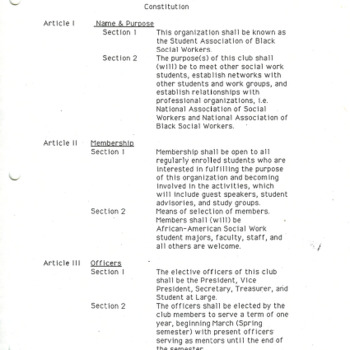 Student Association of Black Social Workers constitution
Johnson was the third African American elected student body president at NC State.
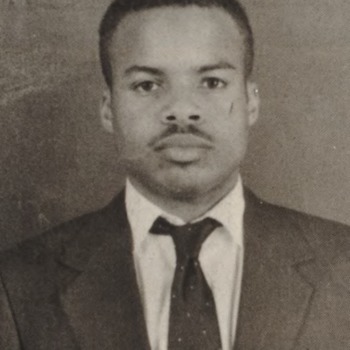 Robert Johnson Jr.
Several student groups organized an anti-hate rally in Harris Field in response to recent rapes on campus, sexual harassment in classrooms, racist remarks from professors, and anti-gay messages in the Free Expression Tunnel.
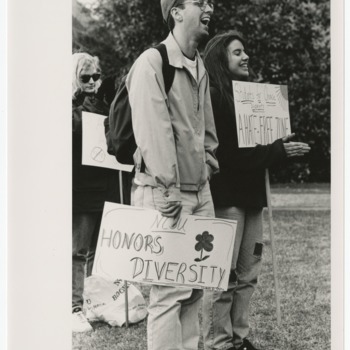 Students attending anti-hate rally
African American students were elected to six top leadership positions. They were Bobby Johnson, Student Body President; Tasha Youngblood, Student Body Treasurer; Kanton Reynolds, Student Body Chief Justice; Tracy Avery, Student Center/UAB President; Christine Verleger, Senior Class President; and Tiffany Price, Senior Class Vice-President;
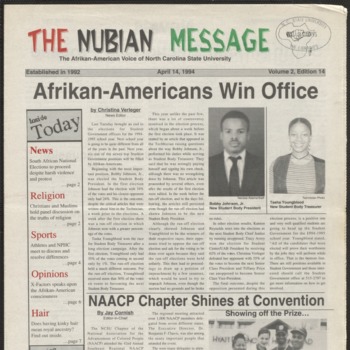 Nubian Message, April 14, 1994
The building formerly known as the Student Center Annex was dedicated to honor Dr. Augustus McIver Witherspoon. It became the first building on campus named after an African American. Dr. Witherspoon earned his PhD in botany from NC State in 1971, making him the second African American student to receive a PhD from NC State. He joined the faculty as an instructor of botany and eventually held the following posts: full professor, assistant dean, Acting Dean and ... More
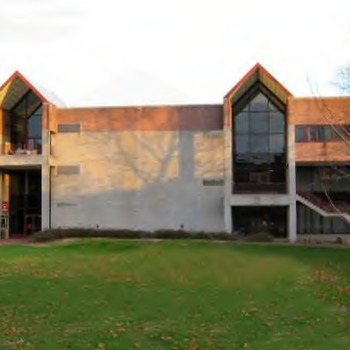 Witherspoon Student Center
Chancellor Larry K. Monteith launched the Diversity Initiative to provide more equitable access to educational resources on campus regardless of race, gender, socioeconomic background, physical disabilities, and other related factors.
Chavonda Jacobs-Young was awarded a PhD. She previously earned a bachelor's degree in 1989 and master's degree in 1992. She was the first African American woman in the United States to earn a PhD in paper science. She later became Associate Administrator for National Programs for the USDA's Agricultural Research Service.
A crowd of approximately 500 students and faculty members rallied in Witherspoon in support of Affirmative Action. Students opposed UNC system President Molly Broad's proposal to eliminate race-based programs within the UNC system.
2000s
University administration created the position of Vice Provost for Diversity and African American Affairs, heading the Office of Diversity and African American Affairs. One stated goal of this position was to improve the experience of black students and other minorities.
Student Body President
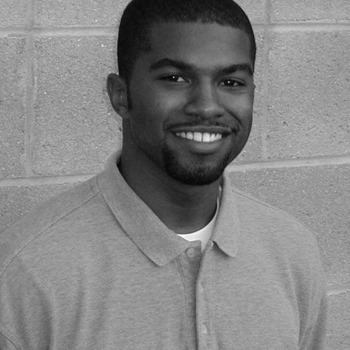 Harold Benjamin Pettigrew
NC State passed Policy 04.25.05, known as the Equal Opportunity, Non-Discrimination and Affirmative Action Policy. The policy supported equal opportunity and affirmative action efforts, and prohibited discrimination and harassment based upon race, color, religion, sex, sexual orientation, gender identity, age, national origin, disability, veteran status, or genetic information.
Student Body President
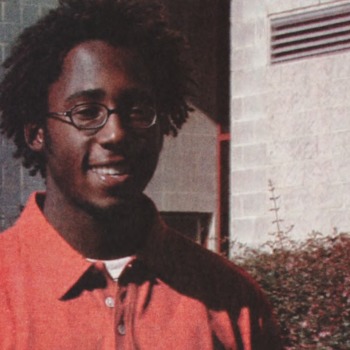 Darryl Willie
The African American Student Advisory Council issued report cards grading the university on enrollment, retention, and graduation of African American students. The report card gave NC State an "F" in recruiting Black students.
Student Body President
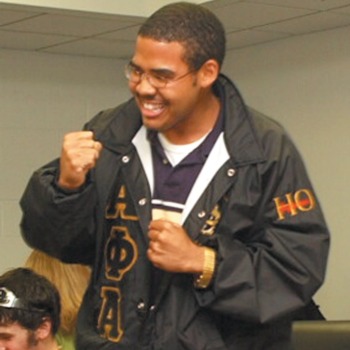 Michael David Anthony
Yolanda King, Martin Luther King Jr.'s daughter, addressed students in Stewart Theatre as part of campus MLK commemoration. King urged a crowd of more than 500 to shake off apathy and tackle social problems such as poverty, hunger, and intolerance.
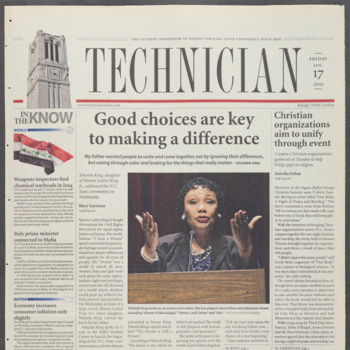 Technician, January 17, 2003
Student Body President
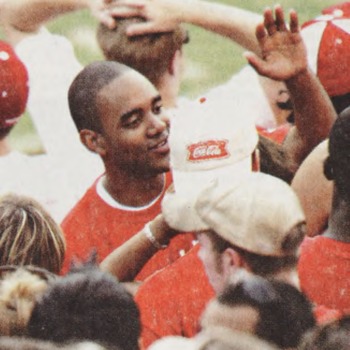 Tony Caravano
Student Body President
African American students participated in a sit-in at a Student Senate meeting to express concern for the lack of funding for African American organizations. Out of $40,000 of appropriations, African American organizations received a mere $755. The Student Senate agreed to send the bill back to committee for re-evaluation.
On August 25, 2005, NC State's student chapter of the NAACP held its first meeting in four years. Gina Dean, the NAACP Youth and College State Director, provided students a brief overview of the NAACP's history. An NC State NAACP chapter initiated in 1991, however, participation in the organization declined until the chapter became inactive. Michael Boykin, later named chapter president, and the Omega Psi Phi fraternity aided in the rechartering of the NC ... More
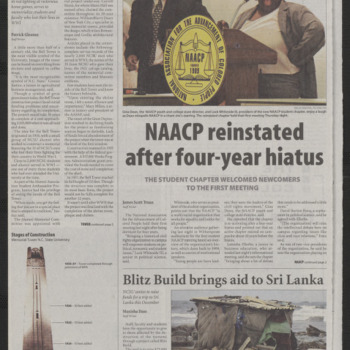 Technician, August 26, 2005
Sidney Lowe served as the first African American head coach of the men's basketball team from 2006 to 2011. Lowe was the starting point guard for NC State's 1983 basketball team which won the national championship.
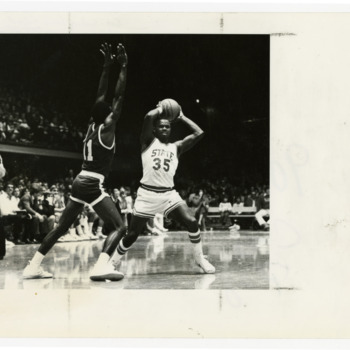 NC State basketball's Sidney Lowe looks for a receiver for his pass
The unit moved into Winslow Hall when the Alumni Association moved to a new building on Centennial Campus.
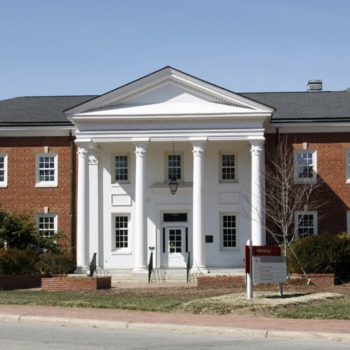 Winslow Hall
The university celebrated the 50th anniversary of the first four African American undergraduate students who had enrolled at NC State. Three of the four were honored at an event in Stewart Theatre.
This organization promoted the success and awareness of African American women in the categories of education, mentoring and tutoring, socioeconomic development and health and wellness.
Russell Wilson was the first quarterback in league history to earn first-team All-ACC honors as a freshman.
Presidential candidate Barack Obama appeared before a crowd at Reynolds Coliseum shortly after winning the Democratic presidential primaries.
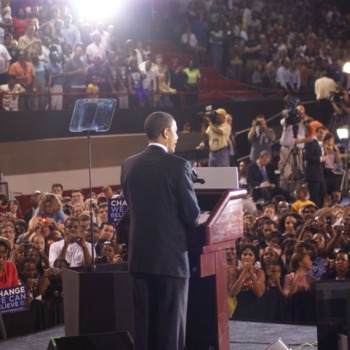 Barack Obama speaking at rally at Reynolds Coliseum
The Office for Diversity and African American Affairs changed its name to Office for Diversity and Inclusion in order meet the needs of students from a variety of backgrounds.
Racist and threatening graffiti directed at President-elect Barack Obama was found in the Free Expression Tunnel. The threats received international media attention and the Secret Service was called to investigate. The four students responsible were identified, admitted to the act, and issued an anonymous public apology. In response to the incident, Chancellor Oblinger established the Campus Culture Task Force Committee to discuss methods of improving the campus ... More
2010s
Racist messages were painted in the tunnel. When they were discovered, students protested against the offensive messages by blocking the tunnel's entrance. Chancellor Woodson released a statement that declared, "We must create an environment and an overall sense of global awareness on campus that encourages and embraces all forms of diversity."
First organized by students in spring 2011, Diversity Education Week became an annual event to promote awareness and understanding of diverse cultures and foster intercultural understanding.
This walking tour of the campus highlighted locations of significance in the lives and experiences of African American students and the larger community. These tours were held every semester, and they were co-sponsored by the NC State University Libraries and the African American Cultural Center.
The first "Respect the Pack" event was held at the Free Expression Tunnel and became an annual event to promote diversity and inclusion on campus.
President Barack Obama spoke before an audience in Reynolds Coliseum and promoted the American Jobs Act.
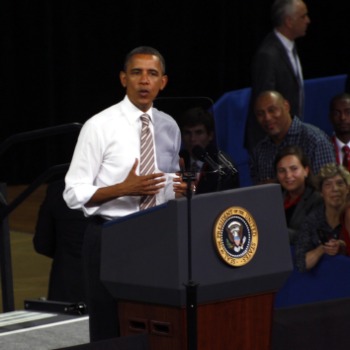 Obama speaking
Dr. Christine Grant, professor of chemical and biomolecular engineering, was awarded the 2012 Stanley C. Israel Regional Award for Advancing Diversity in the Chemical Sciences.
The mission of this organization was "to empower those who identify as a part of the natural hair community to be confident with their natural hair." An additional goal was to combat oppressive and stereotypical beliefs about natural hair.
The purpose of BBSA was to serve and recruit minority students into NC State's Poole College of Management.
Student Body President
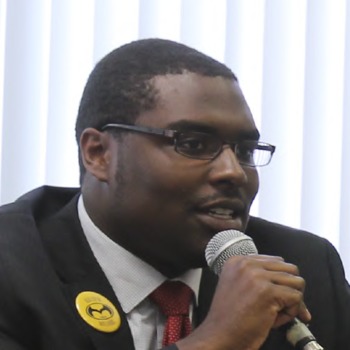 Matthew Williams
President Obama announced the establishment of the Next Generation Power Electronics Innovation Institute. The institute was based at NC State with $140 million in federal funding, including $70 million from the Department of Energy.
NC State researchers led a reenactment of Dr. Martin Luther King's 1960 "Fill Up the Jails" speech at White Rock Baptist Church in Durham, NC. Further works resulted in the Virtual MLK Project that created an immersive experience by placing audiences into a multimedia representation of the church and listening to the speech from various positions around the sanctuary.
Students protested the Mike Brown verdict in Ferguson, MO, at the Free Expression Tunnel along with Blackout protests nationwide. On December 1st, students held a "Walkout" protest and marched from the Court of North Carolina to the Brickyard.
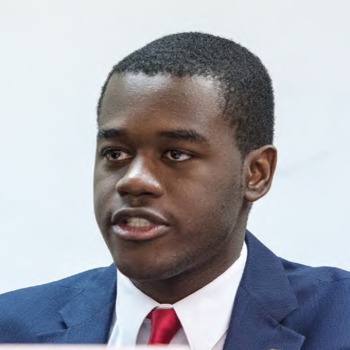 Khari Cyrus
The African American Cultural Center celebrated its 25th anniversary Witherspoon Student Center. The year-long celebration centered on the theme of “Examining Wellness in African American Spaces: Yesterday, Today and Tomorrow." Events included the annual commemoration of Dr. Martin Luther King Jr.; the annual Harambee celebration; the Red, White and Black walking tour; exhibits, talks and presentations; and Wellness Walks and Talks. The Witherspoon-Clark ... More
Three hundred students held a Blackout protesting African American lives lost in police shootings in Charlotte, NC, and Tulsa, OK. The protest began in Wolf Plaza and moved into Talley Student Center, where students performed a die-in. On October 1st, seventy students protested at Carter-Finley Stadium during a football game.
Racist remarks made by NC State students on the messaging app GroupMe became public. Chancellor Woodson issued a statement condemning the messages. On September 29th, student government hosted a Racial Climate Town Hall in Stewart Theatre.
Toni Thorpe retired after 25 years at NC State. Beginning in 2002, she was program coordinator for the African American Cultural Center (AACC). She played crucial roles in a number of events and activities at the center: Harambee; Blacks in Wax Live Museum; Heritage Days; AYA Ambassadors; the Nubian Message; the Red, White and Black Walk; "What’s on the Table" discussions; and MLK Jr. Campus Commemoration.
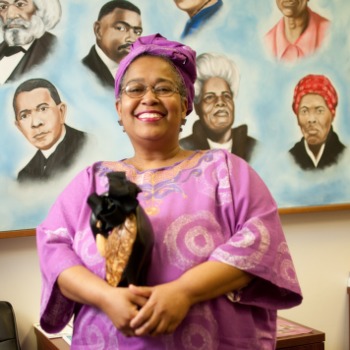 Toni Thorpe
Bradley Chubb was named ACC Defensive Player of the Year. Chubb was later drafted to the Denver Broncos as NC State’s first player taken in the first round of the NFL draft since 2006.
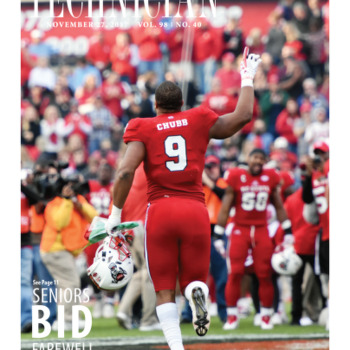 Technician, November, 27, 2017
The First Black Graduate Student Association (BGSA) meeting was held on January 31, 2017. The purpose of BGSA was to create a network of support for black graduate and professional students and to provide an environment that promoted positive cultural awareness and professional growth. The Association for the Concerns of African American Graduate Students preceded and gave formation to BGSA.
Kevin Keatts was named the 20th head basketball coach in school history.
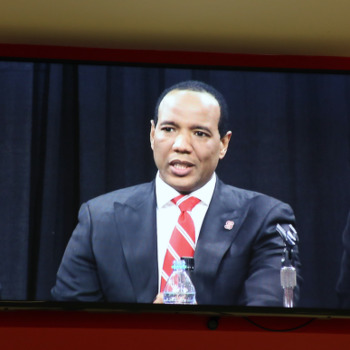 Kevin Keatts Press Conference
The U.S. Postal Service dedicated the 2018 Kwanzaa stamp at NC State's African American Cultural Center (AACC). The Center was chosen to host this event because of its commitment to educating people about the histories, cultures and experiences of African American and Pan-African people. The celebration included music, dancing and special guests.
2020s
The Nubian Message published a special edition on the Black Lives Matter Movement. Topics of discussion included organizing protests and concerns regarding police violence against African Americans.
Dr. Myron F. Floyd was appointed as dean of the College of Natural Resources. He first joined the college in 2005 as a professor in the Department of Parks, Recreation and Tourism Management.
Melanie Flowers became the first African American woman elected student body president at NC State. She was also elected Chair of the Council of Student Body Presidents for the University of North Carolina System.
